
An ambitious promise
At dawn, the shimmering lights of fireworks reflect the vast wooden ring that encircles the Expo grounds, a monumental structure stretching nearly two kilometers. In and around this wooden complex, more than 150 pavilions are arranged, representing 165 countries, regions, companies, and international organizations. Constructed on the artificial island of Yumeshima, literally the “Island of Dreams”, the Osaka 2025 World Expo, exactly one year ago, opened its gates to the public.
The festivities of the first day of the World Expo unfolded as a carefully choreographed spectacle. Crowds gathered early in the morning, moving through security checkpoints with digital maps and QR codes in hand, toward the expansive site, while dignitaries and officials attended formal ceremonies that emphasized global cooperation and shared responsibility for a sustainable future. Prime minister Shigeru Ishiba and Osaka governor Hirofumi Yoshimura highlighted the urgency of planetary challenges in their opening speeches, focusing particularly on the effects of climate change, while in the background colorful performances combined Japanese dance and music with digital projections and futuristic imagery.
“The theme of this World Expo is ‘Designing Future Society for Our Lives’, opened His Majesty Emperor Naruhito of Japan. “Through the Osaka Expo, we hope that people around the world will come to value not only their own lives, but also the lives of those around them, as well as the many forms of life sustained within the natural world. Our goal is to work together to build a sustainable future in which all forms of life are respected.”1
It was clear that the World Expo started off with an ambitious promise: to present a blueprint for a “future society” capable of addressing some of the most pressing global challenges, foremost among them climate change.
The visitor ‘experience’ and translating technology
On the last day, October 13, more than 25 million visitors visited the World Expo.2 For many of them, it was their first time encountering complex concepts such as carbon neutrality, the circular economy, and Green Transformation (GX), terms that already featured prominently in official materials produced by Japan’s Cabinet Secretariat and the Ministry of Economy, Trade and Industry (METI), where the Expo was explicitly framed as a “testing ground for a future society.”3
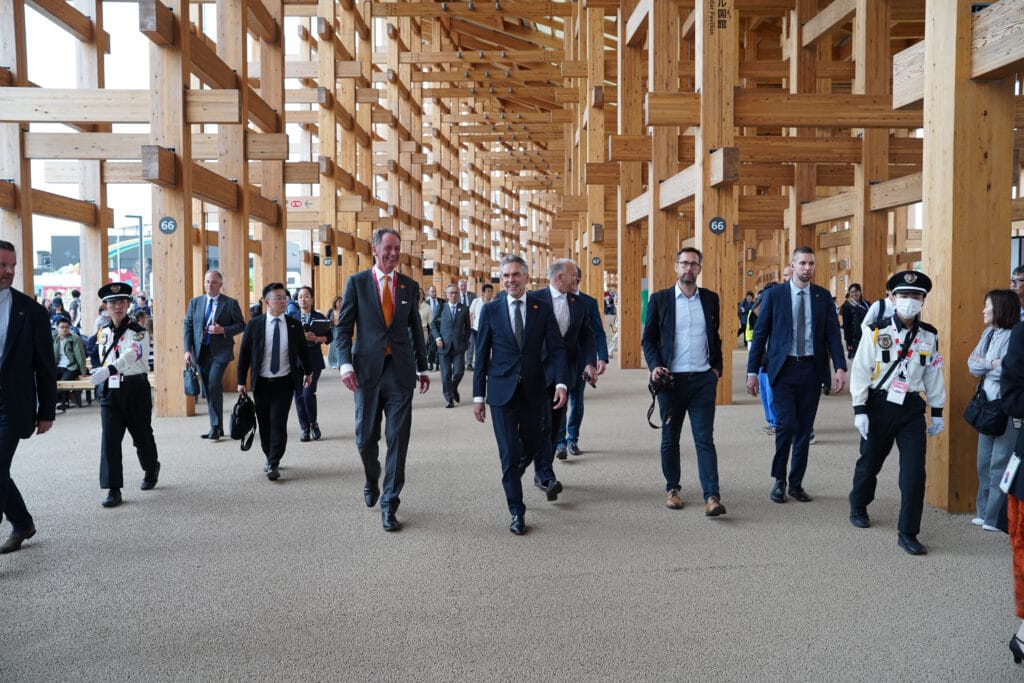
This required a leap in translation for those designing the pavilions, as making the technical details of groundbreaking innovations accessible to an audience can be quite a challenge. In the Japan Pavilion, for instance, the concept of circularity was translated into an architectural narrative, where organic materials, water cycles, and microbial processes symbolized a closed-loop system of life. This difficult theory with a dazzling number of complex words, was expressed through upright wooden planks arranged in a circular formation, through light shows in which drops of water represented the flow of energy, and through Hello Kitty characters dressed as different types of bacteria to illustrate their functions in nature.4
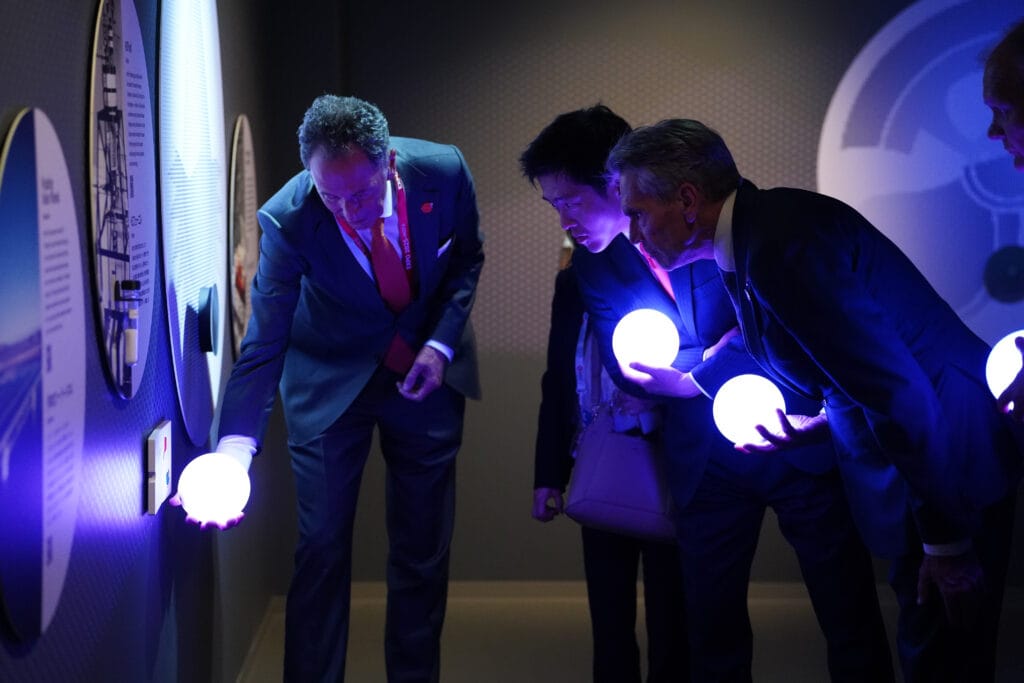
Meanwhile, corporate pavilions such as those by Mitsubishi and Panasonic used interactive displays, virtual reality installations, and hands-on demonstrations; complex systems to translate complex technologies into tangible, everyday scenarios. These included a reading of one’s personality through a computer screen representing the future of Artificial Intelligence, playing around with chip-embedded diamond-shaped plastic toys to demonstrate touch-based technologies, or rooms with 360-degree projections of “possible futures” where visitors were shown the many ways in which humans can live in harmony with machines, and nature.
Numerous experimental installations were scattered across the site, including demonstrations of perovskite solar cells and CO₂ capture technologies. These were framed as near-future realities, for instance through miniature city models in which skyscrapers incorporated such technologies as if already implemented. In this way, the organizers of the Expo and the participating companies and countries were able to portray climate change as a simple problem, one that can be addressed through innovation and technological progress in the future. However, this raises a fundamental question: what kind of “future” is being imagined here?
Expo 2025 as a Climate Utopia
It is important to approach such representations of ideal future societies, not as straightforward predictions. In fact, more often they reveal the limits of what a given society is able to imagine. This is what Fredric Jameson describes as an “archaeological” artifact: a cultural object that, when viewed retrospectively, reveals the contours and limitations of contemporary imagination.5
And at the Osaka World Expo 2025 visitors did not simply learn about the future world; they moved through it. Across the site, these immersive installations and interactive exhibits translated not only technology or innovation into palatable, bite-sized ten-minute stories; they also translated abstract policy goals into lived, physical experiences.
In fact, according to the government’s own action plan, more than one hundred official technological initiatives across thirteen ministries and agencies were implemented on-sites. The Osaka prefectural government, for this reason, describes the Expo as a “laboratory” in which technologies are not only displayed but trialed under real-world conditions.6
Case in point was the Osaka Healthcare Pavilion, which hosted the “Reborn Challenge,” a program that allowed hundreds of companies to test and showcase new technologies directly to visitors. These ranged from health diagnostics, such as real-time body scans to personalized wellness assessments, turning the audience into participants in the experimentation process.
Across these examples, the message is consistent: these are not distant scenarios, but emerging realities. Government reports repeatedly stress “implementation” and “industrialization” as key goals, positioning Expo technologies as scalable solutions that can be rolled out at the site, but naturally, beyond the site itself as well.
This logic aligns with what scholars describe as technological solutionism: the belief that complex environmental problems can be solved primarily through innovation.7 At the Expo 2025, climate change was likewise broken down into engineering challenges: emissions must be captured, energy systems optimized, materials recycled.
The Japan Pavilion offers a clear example of this approach, presenting waste not as a consequence of overconsumption, but as a resource to be reintegrated into circular systems, for instance by converting food waste generated at the event into biofuel. Regretfully, concrete data on the effectiveness of this process could not be verified by the author, despite multiple requests to the pavilion, leaving its actual impact unclear. The same lack of transparency applies to many of the experimental technologies showcased at the World Expo.8
At the same time, this technological framing narrows the horizon of other possible solutions. In fact, structural questions, such as inequality, patterns of consumption, or the organization of the economy, are largely absent. There is no mentionable engagement with concepts such as degrowth, limits to mass production, or other alternative economic models.
As a result, the future presented to visitors is not radically different to their existing lifestyles but carefully adjusted to fit current needs and current consumption patterns. Food may still be wasted, and energy may still be used abundantly. Technology will make sure these issues are solved at the final destination: when the visitor is no longe responsible for the waste they produce. The technologies presented, then, function simply to extend the sustainability of the present, rather than fundamentally transforming the future.
The realities of technology
This vision also sits uneasily with reality on the ground. Reports of logistical strain and infrastructural friction complicate the narrative of seamless technological innovation. Among them, visitors encountering overcrowded transport routes to Yumeshima and public transport disruptions, leaving tens of thousands stranded on the site,9 a ticketing system widely criticized for its complex reservation systems10 and intrusion of privacy.11
More strikingly, methane gas detections on the reclaimed island raised concerns about the environmental stability of the site itself, underscoring the tensions inherent in building a “sustainable” future on an artificial landscape.12
These frictions point to a deeper issue. The Expo’s sustainability narrative largely sidesteps the limits of innovation and the structural drivers of climate change: the capitalist drive for economic growth and increasing consumption.13 In fact, climate action is consistently framed as compatible with these goals, while industrial strategy and market expansion become, for the visitor of the World Expo, an environmental necessity and an excellent opportunity to consume the imagined future as entertainment.
In this sense, Expo 2025 reflects what is often termed ecological modernization, the idea that environmental protection and economic development can reinforce one another, based on a contested assumption: that existing systems can be sufficiently adapted to resolve the crisis they, themselves, have produced.14
The language at the World Expo is that of transformation but leaves its underlying structures intact. The result is a form of utopian thinking that is, paradoxically, conservative. The event, and its participants, does not imagine a world beyond current socio-economic arrangements. It imagines a simple version of that world: cleaner, more efficient, and more technologically advanced, but exactly the same.
The Paradox of Green Growth
Economic models used to measure impact often assume that more spending automatically means more benefit. This means that even when costs rise, the overall “impact” is still counted as positive, simply because more money is being invested.
This point of view is also reflected in the Expo’s approach to climate change, the so-called “green growth” concept. Closely related to terms such as the “green economy,” it builds on earlier ideas of sustainable development, but places a stronger emphasis on the relationship between environmental policy and economic growth. Green growth suggests that economic expansion can be decoupled from environmental harm through technological innovation. In its more cautious form, it argues that environmental protection will benefit the economy in the long run. In a stronger interpretation, it goes further, claiming that environmental policy can actively drive economic growth.15
At the same time, the focus on climate change also serves another purpose: it helps legitimize the Expo. By emphasizing sustainability, the event aligns itself with global initiatives such as the Sustainable Development Goals (SDGs), presenting its outcomes as something to share “widely with the world” and thus, as part of a greater international effort.16
This is not just symbolic. It helps generate public support, justify large investments, and position Japan as a leader in addressing global challenges.17 In this way, climate change becomes both a problem to be solved and a resource to be mobilized, providing legitimacy for projects that might otherwise face greater scrutiny from the public. The concept of spectacle is extremely useful here: as a highly mediated and curated event, the Expo transforms climate action into a visible and consumable experience.18
This very process of staging can obscure underlying contradictions. The environmental costs of construction, for example, or the temporary nature of many installations, and the broader carbon footprint of the event itself, remain largely outside the global narrative of the event. These issues are not included as part of the officially reported outcomes.19 What is foregrounded is the image of sustainability, rather than its full material complexity.
In the case of Expo 2025 Osaka, this tension becomes visible not only in environmental concerns surrounding the Yumeshima site, as mentioned above, but also in the scale and uneven distribution of infrastructural investment required to sustain the spectacle. Government estimates show that direct Expo-related infrastructure costs alone had risen well above initial estimations, to ¥839 billion, with total associated investments reaching into the trillions of yen in 2023, already two years prior to the event. This scale of spending has drawn public scrutiny, particularly in the aftermath of the Noto Peninsula earthquake where over 700 people were killed,20 prompting calls to redirect financial and material resources toward disaster relief and reconstruction.21
At the same time, frictions within the Expo’s production process, such as widespread reports of unpaid construction costs for multiple foreign pavilions and ongoing legal disputes with subcontractors, point to the precarious labor and financial conditions underpinning the event.22
These tensions extend into the aftermath of the Expo itself, where plans for the reuse of pavilion materials have encountered significant financial and logistical obstacles, with only a limited number of structures securing concrete second-life destinations and large volumes of waste anticipated.23
Even as the Expo has been projected to generate an operating profit due to strong ticket sales,24 and to exceed its break-even point,25 these returns remain embedded within a far larger landscape of public expenditure, material waste, and long-term infrastructural commitments.
This raises a fundamental paradox: the creation of a sustainable future is here predicated on processes that are themselves resource-intensive. The site, thus, becomes a space where sustainability is both demonstrated and, in certain respects, contradicted.
One year after the Osaka World Expo
One year after its opening, Expo 2025 can therefore be understood not simply as an event that attempted to design the future, but as one that has begun to define how that future is remembered.26
It leaves behind not only material traces or policy initiatives, but a more elusive yet consequential legacy: a set of images, narratives, and assumptions that will continue to shape the horizon of what is thinkable in the future, in this age of climate change.
To recognize these limitations is not to dismiss the Expo’s contributions. The technologies showcased, the international networks established, and the awareness generated all constitute meaningful elements in the broader effort to address climate change.
However, it is precisely because of the scale and visibility of such events that their underlying assumptions warrant critical attention. In this light, the question is not simply whether the Expo delivered on its promises, but what kinds of futures it has made easier, or more difficult, to imagine.
In fact, I would argue, as climate change continues to intensify, the need for alternative visions becomes increasingly urgent. Whether such visions can emerge within the frameworks exemplified by Expo 2025 remains an open question. What is clear, however, is that the boundaries of the climate future are not only technological or economic; they are also imaginative.
References
- Yomiuri Shimbun, ‘Tennō Heika no Banpaku Kaikaishiki de no Okotoba Zenbun [Full text of His Majesty the Emperor’s address at the World Expo opening ceremony]’, 12 April 2025. ↩︎
- Kyodo News, ‘Osaka expo draws over 25 mil. visitors ahead of closing after 6-month run’, 12 October 2025. ↩︎
- METI, ‘Expo 2025 Osaka, Kansai, Japan: A green transformation testing ground for stable energy supply, decarbonization, and economic growth’, 28 February 2025. ↩︎
- NHK World, ‘Hello Kitty starts as Japan pavilion unveiled at Expo 2025’, 28 January 2025. ↩︎
- Fredric Jameson, Archaeologies of the Future: The Desire Called Utopia and Other Science Fictions, 2005. ↩︎
- Japan Association for the 2025 World Exposition, ‘March 2025 Pre-Event Report: Sustainability Action Plan of Expo 2025 Osaka, Kansai, Japan’. ↩︎
- Evgeny Morozov, To Save Everything, Click Here: The Folly of Technological Solutionism, 2014. ↩︎
- Anoma van der Veere, ‘Japanse Wereldexpo maakt de beloofde technologische utopie nog niet waar [Japan’s World Expo falls short of its promised technological utopia’, NRC, 14 October 2025. ↩︎
- Haruno Kosaka, Mizuki Hayashi, Takumi Fujikawa and Yosuke Tsuyuki, ‘Osaka Metro apologizes after Expo visitors stranded due to train disruptions’, Asahi Shimbun, 14 August 2025. ↩︎
- Joel Tansey, ‘Two months in, Osaka Expo organizer struggles to improve experience as crowds grow’, The Japan Times, 13 June 2025; or for more details see Takeshi Tsuchiya and Yūka Komatsu, ‘Pabirion yoyaku sōdatsusen gekika, netto motōjitsu mo “doko mo muri”… kyōkai saito wa “hanzatsu de torinikui” [Pavilion reservation battle intensifies, “nowhere available” both online and on the day… the association’s website is “complicated and hard to use”’, Yomiuri Shimbun, 30 May 2025. ↩︎
- Akiko Takahashi, ‘Too Much Information: Osaka Expo Website’s Excessive Personal Data Demands’, Nippon.com, 11 April 2025; for more details see Itsuo Higashikubo and Takumi Fujikawa, ‘Naze “kowasugiru” dōi no yōkyū ni? Banpaku chiketto kojin jōhō hogo hōshin [Why is “overly frightening” consent being required? Expo ticket personal data protection policy]’, Mainichi Shimbun, 9 March 2025. ↩︎
- Asako Hanafusa, ‘Explosive gas detected at expo venue one week before opening’, Asahi Shimbun, 7 April 2025. ↩︎
- G. Blanco et al., ‘Drivers, Trends and Mitigation’, in Climate Change 2014: Mitigation of Climate Change, Cambridge University Press, 2014. ↩︎
- Keiichi Satoh, ‘Ecological Modernization Theory and Climate Action’, in The Oxford Handbook of Climate Action, 2025. ↩︎
- Michael Jacobs, ‘Green Growth’, in The Handbook of Global Climate and Environment Policy, 2013. ↩︎
- Japan Association for the 2025 World Exposition, ‘“Expo 2025, Osaka, Kansai, Japan Declaration Forum” Outline’, Press Release: “Expo 2025 Osaka, Kansai, Japan Declaration” Announced, 13 October 2025. ↩︎
- See, for example, Japan’s own declaration for organizing the World Expo 2025: https://www.mofa.go.jp/policy/oda/sdgs/pdf/vnr_column_en.pdf ↩︎
- For a thorough exposition on this concept, please see: Florian Schneider, Staging China: The Politics of Mass Spectacle, 2019. ↩︎
- METI, ‘Ōsaka Kansai Banpaku no kaisai jisseki oyobi seika no seiri (an) [Overview of the achievements and outcomes of Expo 2025 Osaka, Kansai (draft)]’, December 2025. ↩︎
- Sankei Shimbun, ‘Noto jishin giseisha 700-nin chō no mitōshi kanrenshi sara ni fueru kanōsei, jinkō wa 1.1-man nin gen [Death toll from Noto earthquake expected to exceed 700; related deaths may continue to rise, population declines by 11,000]’, 1 January 2026. ↩︎
- Jiji Press, ‘Noto Quake Reignites Calls for Osaka Expo Cancelation’, 23 January 2024. ↩︎
- Asahi Shimbun, ‘Unclaimed pavilions leave expo on hook for 7.7 billion yen’, 26 June 2024; Kyodo News, ‘Subcontractors protest unpaid work on 8 overseas Osaka expo pavilions’, 16 August 2025; Jiji Press, ‘Construction costs allegedly unpaid for three more expo pavilions’, 20 June 2025. ↩︎
- Ayaka Yamane, ‘Planned Reuse, Disposal of Osaka-Kansai Expo Pavilions Run into Financial, Logistical Challenges’, Yomiuri Shimbun, 31 October 2025. ↩︎
- Japan Association for the 2025 World Exposition, ‘Number of visitors and admission ticket sales status’, updated 23 October 2025. ↩︎
- Mainichi Shimbun, ‘Osaka Expo ticket sales reach operating expense break-even point’, 12 August 2025. ↩︎
- Please also refer to: Florian Schneider, ‘Expo Dream Spheres and Tech Utopias: Imagining the Future at the Expo 2025 Osaka, Kansai, Japan’, May 2025, https://leidenasiacentre.nl/imagining-the-future-at-the-expo-2025-osaka-kansai-japan/ ↩︎