
In short
Artificial intelligence is reshaping how disinformation spreads. This report examines how AI intersects with contested information flows in Taiwan, one of the world’s most targeted democracies when it comes to foreign influence and digital manipulation. Drawing on interviews with fact-checkers, policymakers, digital literacy advocates, and analysts, the study explores how Taiwanese society understands and responds to the risks of AI-driven disinformation.
The report finds that disinformation in Taiwan is less about technological novelty and more about underlying political and social tensions. Deep polarisation, particularly around socio-economic inequality, democratic freedoms secured after the martial law period, and cross-strait relations, creates fertile ground for manipulation. Corporate social media platforms amplify emotionally charged content, making anxiety and outrage powerful drivers of visibility and engagement.
AI aggravates these concerns by radically increasing the scope of potential surveillance and analysis, offering the ability to generate fake media content quickly and at low cost, and reproducing or creating social biases through deceptive chatbots.
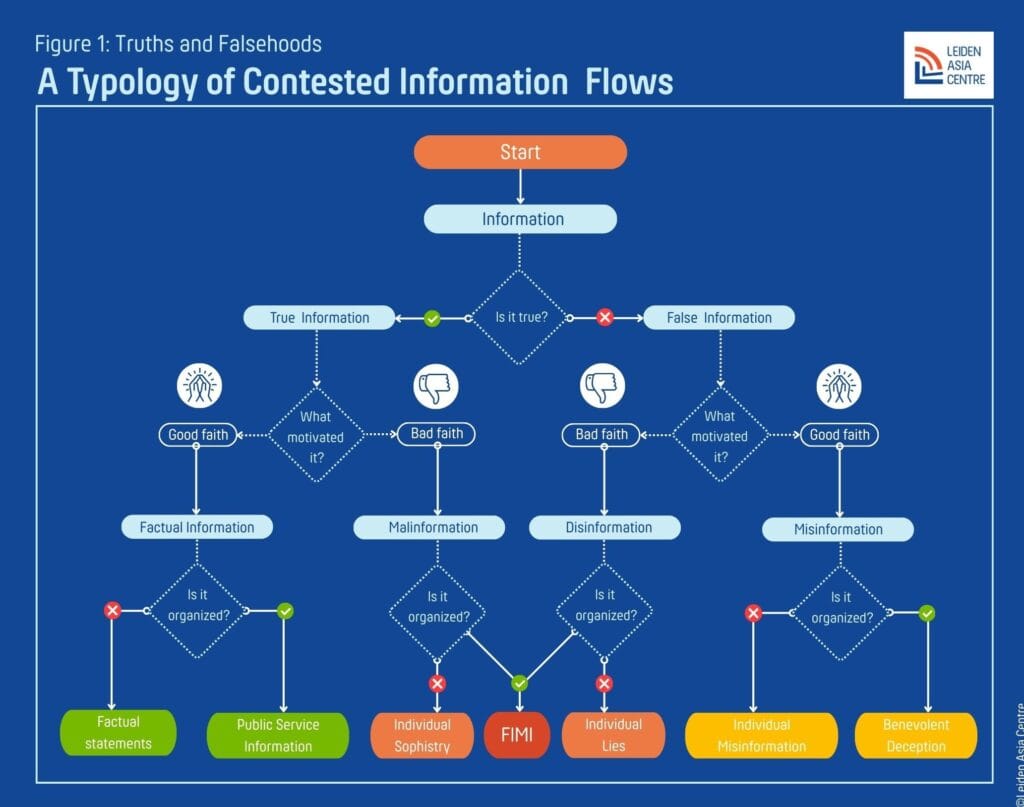
In the face of these challenges, Taiwan has developed a ‘whole-of-society’ approach to counter contested information flows at various levels. Despite its flaws, this pragmatic approach should inspire confidence in the general ability of democratic societies to create resilience against manipulative uses of information. Five concluding lessons stand out:
- Inequality breeds discontent:CIF thrives on dissatisfaction. To extinguish digital wildfires, the priority must be to alleviate socio-economic problems and assure fairness and equity in societies, as disinformation challenges cannot be resolved without addressing the divisive issues that fuel them.
- A robust legal framework is essential, but overreach is a risk:Governance must balance effective regulation against the risks of government overreach on free speech and privacy. Transparency and public oversight are crucial to prevent the abuse of legal frameworks for censorship and political prosecution.
- Support civil society:A lively, independent network of actors (fact-checkers, debunkers, and educators) is ideally suited to act as a CIF watchdog. However, these actors are vulnerable to allegations of being partial, especially when limited resources risk tying them to the interests of specific funders. Civil society actors need appropriate public recognition and broad financial support to maintain independence against vulnerabilities caused by fluctuating private grants and foreign aid.
- Use tech, but not at the expense of interpersonal solutions:While ICT and AI can benefit all aspects of dealing with CIF, tech solutions never exist in isolation. Face-to-face efforts with communities, through outreach and workshops, are essential for teaching skills, making people aware of digital risks, and building a foundation of trust, empathy, and understanding.
- Don’t panic: The language of ‘warfare’ (e.g., ‘battlefields’ and ‘frontlines’) amplifies anxiety and polarisation, ultimately benefitting malicious actors. It is crucial to counter anxieties with levity and humour, placing debate on a pragmatic footing, and moving away from finger-pointing that risks giving more power to bad-faith actors than they deserve. For democratic societies, an important antidote to malicious CIF is, perhaps counter-intuitively, to stay calm and carry on.
About the author
Florian Schneider is Professor of Modern China and Academic Director of the Leiden Asia Centre. He specialises in political communication and digital media in the PRC, with his book Digital Nationalism in China (OUP, 2018) analysing online constructions of Sino-Japanese history. His broader work addresses Chinese foreign policy, governance and soft power, as well as political messaging in popular culture. He also serves as Managing Editor of Asiascape: Digital Asia.

About the project
This study was made possible with the support of a half-year Taiwan Fellowship, awarded by the Centre for Chinese Studies at the National Central Library, financed by the Ministry of Foreign Affairs of the Republic of China, and hosted by the Political Science department of National Taiwan University (an earlier version of this report has been published by the National Central Library’s as Schneider 2025).